
Japan and the Eroding Social Contract

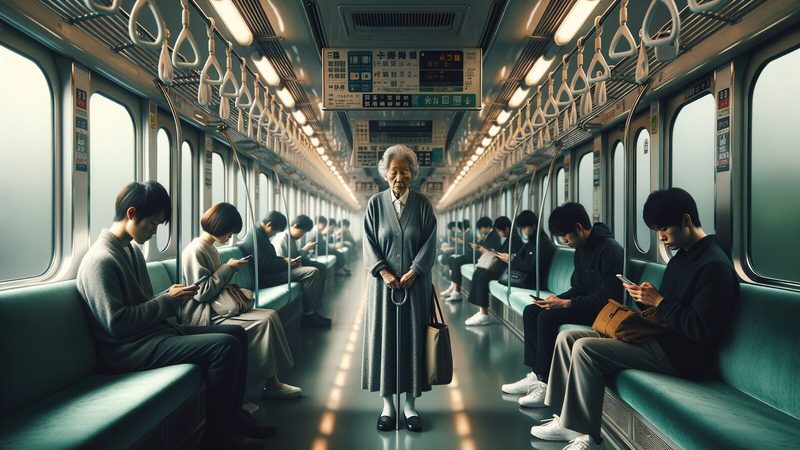
My mom and I are in Japan. We’ve been people-watching for two weeks and we keep landing on the same observation, almost word for word.
This is what the US used to be, isn’t it.
This is what Mexico has never been.
A few moments stuck. On a Tokyo train, a young mother had three kids with her, ages roughly 7 to 12. The two younger boys had stuffed animals out and were starting to get rambunctious. Mom gave them a look. One look. No words. The toys went back in the bags and both boys stood completely still for the rest of the ride. When seats opened up, she gave the older boy another look so he’d slide over and let his sister sit next to her. He moved.
I have not seen a child have a meltdown here. Not once. In the US you see one every five minutes. In Mexico every two.
On that same train, an Indian family barreled past a Japanese woman to grab seats, nearly knocking her down. The Japanese woman gave the Indian mom the most polite expression of contempt I’ve ever seen. The Indian mom sat down next to me. The smell was strong enough that I considered moving. Two cultures, ten seconds apart.
So this post is about why Japan works, why it’s starting not to, and what that says about the US, Mexico, and Europe.
The framework, in one paragraph
Geert Hofstede’s individualism index runs 0 to 100. Higher means the individual is the basic social unit. Lower means the group is. The 61-point gap between Mexico and the US is the largest single axis of cultural difference in Hofstede’s entire dataset.1
| Country | Score | What this looks like in practice |
|---|---|---|
| United States | 91 | Highest in the world. Strong stranger-consideration norms in theory, atomized civic life in practice. |
| Netherlands | 80 | Loose individualist with strong civic infrastructure. |
| Switzerland | 68 | Tight institutions. Individualist values. |
| Germany | 67 | Tight institutions. Ruhezeit is state law. |
| India | 48 | Family-inward collectivism. Strangers carry no weight. |
| Japan | 46 | Civic collectivism. Strangers count because strangers are part of the group. |
| Mexico | 30 | Family-fortified. The consideration radius ends at the property line. |
Source: Hofstede Insights country comparison data1.
That single number doesn’t capture the flavor. Japan’s collectivism is civic. Strangers count because strangers are part of the group. Mexico’s collectivism is family-inward and stranger-blind, which I dug into in my Baja Expat piece on Mexico’s noise culture. The family gets everything. The stranger gets nothing, not even hostility, just an absence of thought. India looks structurally similar. India is the Mexico of Asia.
That’s why a Japanese mom with three kids on a train is a study in courtesy. And why an Indian family on the same train can knock people over without registering it.
What Japan still has
The bike test. Tokyo is the largest urban region on earth, around 37 million people, and most don’t lock their bicycles. They lean them against a wall and walk away.
| City | Homicide rate per 100,000 | Bicycle theft norms |
|---|---|---|
| Tokyo (23 wards) | 0.4 | Most bikes unlocked. If yours is gone, a drunk borrowed it home from the last train. |
| London | ~1.5 | Modest. Lock your bike. |
| New York City | ~5.0 | High. U-lock plus chain. |
| San Francisco | ~6.0 | Catastrophic. Regular cyclist has roughly a 50% lifetime chance of having one stolen. |
Source: Tokyo Metropolitan Police 2024 data2, industry estimates of US bike theft3, Economist Intelligence Unit Safe Cities Index4.
In Mexico your bike gets stolen and stripped before you finish ordering coffee. Lock or no lock.
The Japanese mechanism is meiwaku, “causing trouble for others.” It’s the foundation under everything from train silence to taking your trash home because there are no public bins. You don’t avoid meiwaku because there’s a fine. You avoid it because being someone who imposes on others is shameful. Children internalize it through shitsuke, which folds training, manners, and self-restraint into one word.
I watched a Japanese mom on the Yamanote line take a melting-down toddler off the train, crouch on the empty platform, quietly correct him there, and get back on three trains later. The American version is the kid screaming in aisle 4 at Target while mom yells back. The Mexican version is the parents not noticing.
The cracks
Here’s the sad part. Japan is losing it.
Aruki-sumaho. “Walking smartphone.” In 2020, Yamato City became the first municipality in Japan to ban phone-walking in public. Their pre-ordinance survey found 12% of pedestrians were already doing it. Tokyo Fire Department had hospitalized 165 people from smartphone-related collisions over four years.5
The priority-seat charade. The Ministry of Land, Infrastructure, and Transport ran a survey where 80% of Japanese adults claimed they “often” or “occasionally” yield priority seats to elderly riders.6 Self-report says 80%. Eyeballs say something else. I’ve watched tiny grandmothers struggle to stand while able-bodied 25-year-olds pretend not to see them, scrolling. Signs in every car. Announcements every few minutes. Doesn’t matter.
Monsutā pearento. “Monster parents.” A term that hit the mainstream around 2007 and now has its own Fuji TV drama. Parents who refuse to discipline their kids and attack teachers who try. Parents who demand schools fire teachers over minor disciplinary actions. Parents who refuse to pay school lunch fees because the food “doesn’t taste good.”
Hikikomori. A 2022 Japan Cabinet Office survey put the number who’ve withdrawn from public life entirely at 1.46 million.7 Average duration in the condition is about 10 years. There’s a formal policy term now, the “8050 problem,” for parents in their 80s caring for shut-in adult children in their 50s.
The Streichbruder incident
In April 2025, a 17-year-old German named Simon Both, who goes by “Streichbruder” online, flew to Japan. Within days he was filmed on the Yamanote line with a suitcase-mounted Bluetooth speaker blasting music on a packed Tokyo train, then doing backflips on the Shibuya platform. Japanese netizens called for his deportation. He was effectively run out of the country.8
If a Japanese kid had done that on the Mexico City metro, no one would’ve blinked. They would’ve turned up their own speaker. In Tokyo it was unthinkable. That’s still the social contract working, even as it’s being tested. The 2024 Mainichi Shimbun survey of 7,800 foreign visitors had “bad manners” as the second most-cited tourism problem after congestion.9
Imagine the inverse. A Japanese tourist in India, eating a burger in front of a temple, expecting locals to find that adorable. They wouldn’t, because that’s not a thing they do. The asymmetry is the point. Indians rich enough for a long-haul ticket don’t extend their host countries the same respect they expect at home. The cow is sacred there. Try eating one and see what happens. But on a Tokyo train at 1pm, the rules apparently don’t apply.
The demographic squeeze
Japan’s population dropped by 908,574 native citizens in 2024 alone. Largest annual decline ever recorded. Sixteenth consecutive year.10 Recruit Works Institute projects a labor shortfall of 11 million workers by 2040.11
So Japan is doing what it resisted doing for decades. Importing labor. The Specified Skilled Worker visa launched in 2019 and the holder count just hit a record 390,296 at the end of 2025.12 The largest groups come from Vietnam, Indonesia, the Philippines, Myanmar, and China. Policy discussions are now about bringing in 1.23 million more by 2029.
| Year | Halal-certified restaurants in Tokyo | Muslim population in Japan |
|---|---|---|
| 2010 | n/a | 110,000 |
| 2013 | 4 | n/a |
| 2018 | 180+ | n/a |
| 2024 | 300+ | ~350,000 |
Source: Nippon Asia Halal Association via Salaam Gateway, Kyodo News13.
I’ve met people from Nepal, Bangladesh, and Myanmar in convenience stores and restaurants this trip. They’re polite, they work hard, they’re trying to learn the rules. Pork is life in Japan, so seeing halal signs in the 7-Eleven is a real shift.
I’m not complaining. Japan needs the workers. But the social contract Japan has runs on shared, internalized norms that took generations to build inside a culturally homogeneous society. Importing 1.2 million workers from places with very different public-conduct norms, even respectfully, erodes the shared substrate. Young Japanese aren’t fully carrying it forward. New arrivals haven’t fully absorbed it. The elders are dying at nearly a million a year. Do the math.
The US, Mexico, and Europe
The US: trust collapsed and we called it progress
Robert Putnam’s Bowling Alone tracked it falling across seven measures.14
| Year | Trust in federal government | “Most people can be trusted” |
|---|---|---|
| 1964 | 77% | ~58% |
| 1972 | ~54% | 46% |
| 2000 | ~30% | ~36% |
| 2024 | 22% | 34% |
Source: Pew Research Center, General Social Survey15.
For the first time, the US ranks dead last in the G7 in trust in government, courts, elections, and military.15 The same individualism that produced American freedom of expression and entrepreneurship also produced atomization. We outsourced civility to whoever was loudest. The bike thief, the package thief, the guy with the speaker on the LA Metro, the kid having a tantrum while mom watches TikTok. They’re reading the same signal. Nobody is going to stop me. Nobody is even watching.
Mexico: family-fortified, stranger-blind
Mexico isn’t atomized, it’s family-fortified. Inside the family unit you get extraordinary loyalty. Outside it, the consideration radius ends at the property line. Nobody can enjoy a beach or a hike or a national park because someone always brings the speaker. The noise pollution travels with the people.
Europe: the institutional scaffolding still holds
Europe is the interesting middle. What Europe has that the US lost is the institutional scaffolding. In Germany, Ruhezeit (quiet hours) isn’t politeness. It’s state law. Nightly quiet from 10pm to 6am. All-day quiet on Sundays. Midday quiet windows in southern states. Most retail is legally closed on Sundays. You can call the cops on a 7:30am Sunday lawnmower and they’ll come.16
The same individualism drift is happening in Europe. But the scaffolding holds the floor up while the values shift. The US tore the scaffolding out and called it freedom.
The bathroom
One last thing my mom kept circling back to. A train station bathroom had a little station with paper rolls and alcohol spray asking you to clean the seat for the next person. She did it. She came out beaming. “How is this not everywhere?”
In Mexico, public bathrooms have toilet paper in trash cans because the plumbing can’t handle flushing, and that paper is on the floor by 9am. In the US the seat has been peed on by someone who didn’t bother to lift it. In Japan the seat has often already been warmed and sanitized for you.
That’s not a plumbing difference. That’s a meiwaku difference. Don’t impose on the next person. The next person is part of the group. You are the next person too.
Japan, the country that figured out how to make a 37-million-person city quiet, is losing it. To phones. To monster parents. To 17-year-old German YouTubers. To a population pyramid shaped like a candle. To a labor pipeline bringing in people from cultures whose public norms look nothing like Japan’s.
In ten or twenty years, Tokyo’s metro will probably look more like LA’s. The bikes will start getting locked. The grandmothers will stand. Some kid will play TikTok at full volume and people will glance and look away, the way they do everywhere else.
I hope I’m wrong. I’d love to come back in 2046 and find a young Japanese mother giving the same single look to her boys, and the boys still putting the toys down. The fact that I’m not confident she’ll be there is the saddest thing about this trip.
In the meantime, my mom and I are soaking it in. Trying to remember what it felt like, in case we never quite see it again.
-
Hofstede Insights. Country Comparison Tool. Replicated across multiple academic sources including Hofstede, G. (2011). Dimensionalizing Cultures: The Hofstede Model in Context. Online Readings in Psychology and Culture. ↩ ↩2
-
Tokyo Metropolitan Police Department. (2024). Annual crime statistics. Reported via Japan Neighborhoods, “Is Tokyo Safe?”. ↩
-
529 Garage and Bike Index industry estimates, citing FBI Uniform Crime Reporting program (~150,000 documented annual cases) and industry-adjusted figure of roughly 2 million bikes per year actually stolen. Bike Index reporting. ↩
-
Economist Intelligence Unit. (2024). Safe Cities Index. ↩
-
BBC News. (June 2020). The Japanese city that banned ‘smartphone-walking’. Yamato City pre-ordinance survey originally reported by Mainichi Shimbun. ↩
-
Japan Today. (2023). Who has first claim to the priority seats on public transport? Citing Ministry of Land, Infrastructure, Transport and Tourism survey of 985 adults. ↩
-
Japan Cabinet Office. (2022). National survey on hikikomori. Cited in OECD Youth Policy Toolkit, 5-day Hikikomori Intervention Japan. ↩
-
Tokyo Weekender. (April 2025). TikToker Streichbruder’s Tokyo Train Antics Spark Outrage. See also Japan Insides coverage. ↩
-
Mainichi Shimbun. (2024). Survey of 7,800 foreign visitors to Japan. “Bad manners” cited as second-most common tourism problem after congestion. Coverage in Yomiuri Shimbun corroborates resident-side complaints in Kyoto (~90% concerned with overtourism). ↩
-
CNN. (August 2025). Japan’s population decline keeps getting worse. Last year, it saw a record drop. Citing Japan Ministry of Internal Affairs and Communications data. ↩
-
Recruit Works Institute. (2023). Future Predictions 2040 in Japan: The Dawn of the Limited-Labor Supply Society. ↩
-
The Japan Times. (March 2026). Japan’s tally of specified skilled workers hits record 390,296. Citing Immigration Services Agency. ↩
-
Salaam Gateway. (2024). Japan’s halal food market poised for growth amid rising Muslim demand. Citing Kyodo News and Nippon Asia Halal Association data. ↩
-
Putnam, R. (2000). Bowling Alone: The Collapse and Revival of American Community. Simon & Schuster. Original 1995 essay version available via Journal of Democracy archive. ↩
-
Pew Research Center. (May 2025). Americans’ Declining Trust in Each Other and Reasons Behind It. Pew Charitable Trusts. (Fall 2024). Americans’ Mistrust of Institutions. ↩ ↩2
-
IamExpat Germany. Ruhezeit: What you need to know about quiet hours in Germany. Codified in Landesimmissionsschutzgesetz (state-level emissions protection acts). ↩
More like this

FarNiente Caffee at Telefonica Gastro Park
I’m a huge fan of pretty much everything Mexican, especially Mexican food. One of my favorite things to do is to go to Tijuana, BC to get...

Canyon Overlook Trail at Zion NP
The West Temple, Towers of the Virgins, Streaked Wall, and Beehives all make up part of this tremendous view. The East Temple rises direc...

Cooking a Ribeye Steak in a Cast Iron Skillet
Cooking a Ribeye Steak in a Cast Iron Skillet
Comments
Comments are powered by Disqus, which sets third-party cookies. Click above to load.